

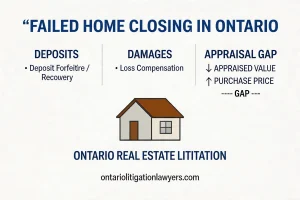
 Quick Answer: If a buyer fails to close a home purchase in Ontario due to an appraisal gap or financing issue, they can lose their deposit and may also be sued for the seller’s losses, including the difference between the original price and the resale price.
In the 2026 Ontario market, appraisal gaps are a growing cause of failed real estate transactions. When a lender values a property below the agreed purchase price, buyers can face a sudden financing shortfall they cannot cover.
This is where a financing issue quickly becomes a legal dispute.
If a closing is at risk, the consequences can escalate quickly:
- Sellers may be entitled to keep the deposit
- Buyers may face lawsuits for resale losses
- Additional claims may include carrying costs and legal fees
These disputes are increasingly common across Toronto and the GTA, including North York, Vaughan, Markham, Richmond Hill, and Aurora, especially in shifting market conditions.
This article breaks down:
- What an appraisal gap is and why it matters
- What happens to the deposit when a deal fails
- The financial risks of a failed closing
- What steps to take immediately to protect yourself
For more guidance on purchase and sale disputes, explore our Toronto Real Estate Litigation services and how our team handles complex real estate disputes across the GTA.
About Powell Litigation
Powell Litigation is a Toronto-based civil litigation firm representing clients in high-stakes real estate disputes across the GTA. Led by senior litigation counsel Weston Powell, the firm focuses exclusively on litigation, including failed real estate transactions, contract disputes, and complex financial claims.
What is an Appraisal Gap and How Does it Kill a Real Estate Deal?
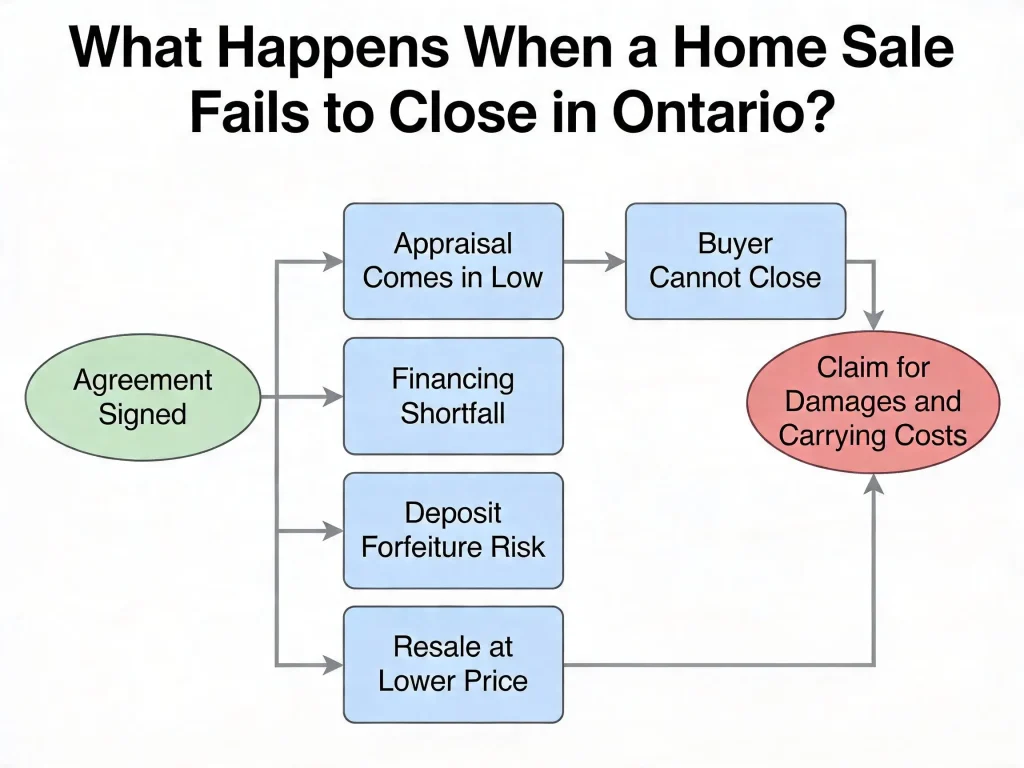
An appraisal gap is the difference between the price a buyer agreed to pay and the lower value assigned by the lender’s appraiser, and that gap can kill a deal when the bank refuses to finance the full purchase price and the buyer cannot make up the shortfall with cash.
Here is how an appraisal gap typically unfolds in Ontario real estate transactions:
- The buyer agrees to purchase a home at a fixed price.
- The lender orders an appraisal before closing.
- The appraisal comes in lower than the agreed purchase price.
- The bank reduces the amount it is willing to lend.
- The buyer must cover the shortfall out of pocket or risk default.
In a cooling or shifting 2026 Ontario market, appraisal gaps are becoming more common as lender valuations adjust faster than buyer expectations.
Can a Seller Keep the Deposit if the Deal Falls Through?
Under Ontario law, a seller can often keep the deposit if the buyer breaches the Agreement of Purchase and Sale by failing to close, even without proving actual damages, although relief from forfeiture may apply in rare circumstances.
In most failed closing scenarios, the deposit serves as:
- A sign of the buyer’s commitment to the transaction
- Security for the seller in case of default
- A form of liquidated damages if the deal collapses
Courts may consider relief from forfeiture, but this is highly discretionary and depends on:
- The size of the deposit relative to the loss
- The conduct of both parties
- The terms of the Agreement of Purchase and Sale
- Whether forfeiture would be unconscionable
The Financial Risk: Being Sued for the Difference in Value
If a buyer fails to close and the seller later resells the property for less, the buyer may be liable for the difference in value along with additional financial losses.
Potential damages in a failed closing lawsuit may include:
- The difference between the original purchase price and the resale price
- Mortgage interest incurred during the delay
- Property taxes and utilities
- Additional legal and real estate fees
- Costs associated with re-listing and marketing the property
For example, if a property was originally sold for $1,000,000 but later resold for $850,000, the defaulting buyer could face a claim for the $150,000 shortfall plus carrying costs.
Case Law Snapshot: Ontario Superior Court and Relief from Forfeiture
Ontario courts generally enforce deposits after a buyer default, and while relief from forfeiture exists, it is the exception rather than the rule in real estate litigation.
In real-world litigation, judges look closely at proportionality, fairness, and the actual harm caused by the breach. But buyers should not assume the court will rescue them simply because the result feels harsh. Relief from forfeiture is highly discretionary. Courts are usually reluctant to interfere with a negotiated deposit unless the facts strongly justify it.
That is why these cases are often fought in the Ontario Superior Court of Justice with detailed evidence about the contract, the failed closing, financing history, resale efforts, market conditions, and the seller’s losses. A litigation strategy built around evidence is usually far more important than a general claim that the result is unfair.
At Powell Litigation, we understand how these disputes develop in practice. In recent GTA market shifts, our team has helped sellers pursue deposits and protect their rights after buyers walked away due to financing failures and closing-day defaults.
3 Immediate Steps to Take if Your Closing is at Risk
If your closing is at risk, taking immediate action can reduce financial exposure and preserve legal options.
- Request an Extension: Contact the other party immediately to negotiate a short extension if financing is delayed.
- Explore Alternative Financing: Consider bridge loans or private lending to cover short-term gaps.
- Speak with a Litigation Lawyer: A litigation-focused strategy is critical once a closing is at risk of failing.
Common Questions About Failed Home Closings in Ontario
Can a buyer get the deposit back if financing falls through?
Sometimes, but usually only if the agreement included a financing condition that was properly used or if there are unusual facts that support relief from forfeiture. Once conditions are waived, financing failure often does not excuse non-performance.
Can the seller sue even after keeping the deposit?
Yes. In many cases, the seller may keep the deposit and still sue for additional damages if the resale price is lower or if the seller incurred carrying costs because of the failed closing.
Does the seller have to resell right away?
The seller must usually take reasonable steps to mitigate losses, but what is reasonable depends on the market, the property, timing, and the evidence. Buyers who argue poor mitigation need strong proof.
What court handles these disputes in Toronto?
Depending on the amount and issues involved, these disputes are often handled in the Ontario Superior Court of Justice. Smaller claims may sometimes fall within Small Claims Court limits, but many failed-closing disputes exceed that threshold.
Why This Matters for Toronto and GTA Buyers and Sellers
Failed closings are not just downtown Toronto issues. We regularly see the same risks affecting transactions across the GTA, including North York, Scarborough, Etobicoke, Vaughan, Markham, Richmond Hill, Newmarket, and Aurora. In every one of those markets, a missed closing can trigger immediate financial pressure and fast-moving legal decisions.
Whether you are a seller trying to preserve value after a buyer walks away or a buyer facing a potential claim after financing collapses, the first days after the failed closing often shape the entire case.
Contact Powell Litigation
Closing at risk? Whether you are a seller trying to protect your property value or a buyer facing a major damages claim, time is your enemy. Contact Ontario Civil Litigation Lawyers today for a strategic assessment of your real estate dispute.
If you need help with a failed transaction, deposit dispute, or resale damages claim, our team can assess your options and build a strategy tailored to the realities of Toronto real estate litigation.